Tell us about the job
Takes about a minute. No obligation.
Getting the sizing right before a furnace goes in matters more than most homeowners expect. Homes in Lincoln County, NE run heat about eight months a year, from October through May. The burner and ignition system cycle repeatedly through those months, and the heat exchanger carries that load every year. A unit that a contractor undersizes, or installs with duct runs that fight the airflow, works harder than it should on every call for heat. That extra strain accumulates on the parts least able to absorb it, and a licensed installer doing a proper load calculation before the job starts is what keeps the equipment from spending its early years already behind.
Ductwork laid in for an earlier generation of heating equipment carries assumptions about airflow, trunk sizing, and return placement that a new furnace does not share. Half the homes in Lincoln County, Nebraska were built in 1970 or earlier (2020-2024 ACS 5-year). That spread in the housing stock means a contractor opening up a job here finds ductwork that may need to be rebalanced, rerouted, or partially replaced before the new unit performs as rated. The furnace itself gets specified quickly. What takes the work is what the house already has behind the walls.
What Gets Installed With a New Furnace
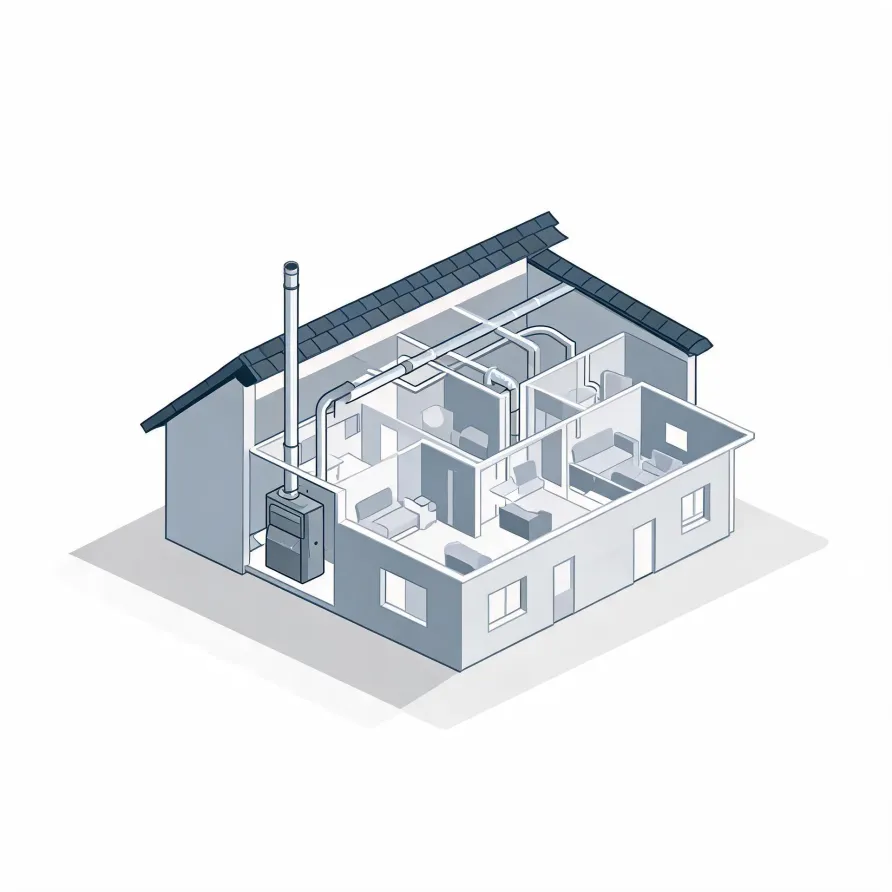
The furnace itself sits in a mechanical room, basement, or utility closet and is the core unit a contractor places first. Attached to it is the flue or vent pipe, which runs through the wall or up through the house to carry combustion gases outside. The air handler section, built into the furnace cabinet, pulls household air in and pushes conditioned air back out.
A new thermostat goes on an interior wall, usually a central hallway, and gives the homeowner direct control over the system. The furnace also connects to a gas line and to supply and return duct openings in the wall or floor nearest the unit. A condensate drain line runs from high-efficiency units to a nearby floor drain.
The drawing shows a typical layout, and a licensed contractor determines exactly what applies to your house and its existing setup.
Get matched in Lincoln CountyLincoln County, Nebraska, by the numbers
493 severe weather events were recorded in Lincoln County, Nebraska between 2015 and 2024.
NOAA National Centers for Environmental Information, Storm Events Database, bulk CSV export, events 2015-01-01 through 2024-12-31.Half the homes in Lincoln County, Nebraska were built in 1970 or earlier (2020-2024 ACS 5-year).
U.S. Census Bureau, 2020-2024 American Community Survey 5-Year EstimatesLincoln County, Nebraska holds 16,624 housing units (2020-2024 ACS 5-year).
U.S. Census Bureau, 2020-2024 American Community Survey 5-Year EstimatesOwners occupy 65.6% of the occupied homes in Lincoln County, Nebraska (2020-2024 ACS 5-year).
U.S. Census Bureau, 2020-2024 American Community Survey 5-Year EstimatesFurnace Installation Rules & Standards for Lincoln County, Nebraska5 sourced rules and standards
What the installation looks like in Lincoln County
Non-weatherized gas furnaces manufactured on or after November 19, 2015 must reach 80.0 percent AFUE.
Non-weatherized oil-fired furnaces manufactured on or after November 19, 2015 must reach 83.0 percent AFUE.
Mobile home gas furnaces manufactured on or after November 19, 2015 must reach 80.0 percent AFUE.
Non-weatherized gas furnaces manufactured on or after December 18, 2028 must reach 95.0 percent AFUE, up from the 80.0 percent minimum that applies to units manufactured before that date.
Licensing and Legal Requirements in Lincoln County, Nebraska
Nebraska requires registration rather than a licence: a contractor must be registered with the Department of Labor before performing any construction work, though anyone earning less than five thousand dollars a year from construction services is not a contractor under the Act at all.
Severe Weather Events in Lincoln County
Nebraska weather puts real demands on heating equipment, and Lincoln County gets its share of conditions that push furnaces hard. How often that happens locally shapes what a furnace needs to handle and how a contractor sizes and installs it here.
493 severe weather events, 2015–2024. Source: NOAA National Centers for Environmental Information, Storm Events Database.