
Furnace won't turn on in Grand Island, NE

Fill out one form

A furnace that won't start is a bad surprise on a cold Grand Island morning, and the usual next step is a string of phone calls: searching for a contractor, calling around to see who answers, explaining the same problem to each one, then trying to weigh quotes that don't line up. This page skips that. One request connects you to a licensed contractor working in Hall County, someone who deals with furnaces all winter and knows what tends to fail when a system won't fire, whether that's the igniter, a safety switch, or something with the gas supply. You get one call, not five, and no round of comparing strangers. Just answer a few questions about your furnace and what it's doing, and the request goes to someone local who can look at it.

A furnace that won't turn on usually comes down to one of a few things. No power to the control board, a thermostat set wrong or dead on batteries, a flame sensor too dirty to signal the burners, or an igniter that's worn out and won't glow. If the blower runs but no heat follows, the problem is likely the igniter or the gas valve rather than the electrical side. If nothing happens at all, not even the blower, check the breaker and the furnace switch first, since that's an easy thing to rule out before anything else. Hall County winters don't leave much room for a furnace to sit broken. A house can lose heat fast once the temperature outside drops below freezing, and pipes are part of what's at risk, not just comfort. Once the simple causes are ruled out, the rest calls for someone who can open the unit, test the parts with a meter, and find which one actually failed.

A basement utility area with a gray furnace, sheet-metal ductwork, pipes, plastic-covered walls, a concrete floor, and a black shelving unit holding storage bins.

Running the way it should

A furnace like this fires on command and holds steady through a Hall County winter. Air moves through the ductwork at a steady rate, the gas line feeds the burners clean, and the condensate line drains off without backing up. Nothing about it needs your attention.


A gray metal furnace with louvered vent panels stands on a concrete basement floor beside galvanized ductwork, gas and plastic pipes, and foil-faced insulation along the ceiling and wall.

Worn out and struggling

Surface rust on the cabinet usually means years of sitting in a damp basement, and a furnace this old wears out the same parts that make it start: the igniter, the flame sensor, the control board. Once one of those goes, the burners never get the signal to light.

Quick Check or Call for Help

Call a tech now

  • A furnace that won't fire at all, even with the thermostat set high, usually means no power to the control board or a failed igniter, and that's not a safe thing to leave overnight.
  • If the blower runs but no heat follows, the flame sensor likely can't see a flame to signal the burners, and that part has to be cleaned or swapped before the furnace will hold a cycle.
  • A furnace that was working and then quit outright, especially with any burning smell or repeated clicking at the control board, needs a look before you run it again.
  • Hall County winters don't leave much room to wait out a dead furnace, and a tech who works on this equipment every season will know what usually fails first.
  • A no-call bill from a furnace that won't start at all is a straightforward diagnosis, since the symptom points at a short list of parts.

Try this first

  • Check the thermostat before anything else. Dead batteries or a setting bumped too low will stop a furnace cold with nothing actually wrong.
  • Look at the breaker panel. A tripped breaker cuts power to the furnace the same way a bad igniter does, and resetting it costs you nothing.
  • Check the furnace door. Most units have a safety switch that won't let the furnace run unless the access panel is seated and latched shut.
  • If you've got a gas furnace, confirm the gas valve is turned to the on position. It's an easy one to overlook after any work near the line.
  • A furnace that runs fine once these are ruled out probably doesn't need a service call at all.
A woman in a knitted shawl sits in a living room with a fireplace, shelves, a sofa with cushions, and a lamp by a bright window, looking off to the side.
A woman with long brown wavy hair in a green shirt over a white top stands in a living room with built-in white shelves, a ceiling fan, a potted plant and a sliding glass door.
A woman with shoulder-length gray-streaked hair in a light gray knit sweater stands smiling and looking off to the side in a living room with a sofa, houseplant, framed picture, and sunlit sliding glass door.
A woman with shoulder-length curly gray hair wearing a gray knit sweater stands near a window with a sheer curtain, looking to the side, with a blurred interior room behind her.

Why is a working furnace non-negotiable here

  • Winter nights average 17°F

    Overnight lows average 17°F through December, January and February, per weather data for Hall County. A furnace that won't start on a night like that isn't a minor inconvenience.

  • Heat runs October through May

    Furnaces here run from October through May, about eight months of the year. That long a stretch means a dead furnace will happen on a cold day far more than a warm one.

  • 63.7% of homes heat with gas

    63.7% of homes in Hall County heat with gas, according to Census data. If a furnace won't turn on, the usual cause is tied to the gas supply, the ignition system, or the controls that manage both.

NOAA nClimDiv 1991-2020 · ACS 2020-2024

  1. Thermostat calls for heat and signals the control board

  2. Control board checks the limit switch and draft inducer

  3. Inducer motor starts and proves draft through the pressure switch

  4. Igniter heats up or sparks to light the burners

A beige furnace with two access panels stands against a concrete basement wall, with galvanized sheet-metal ductwork, a white PVC pipe, flexible conduit and insulated ducting around it.
Before you get your furnace repair
A gray furnace with white PVC vent pipes stands beside sheet-metal ductwork in a basement with a smooth concrete floor, exposed wood framing, and plastic sheeting on the walls.
After you get your furnace repair

No calling every shop in Hall County

A furnace that won't start doesn't wait for a convenient time, and neither does the cold once it sets in over Hall County. The instinct is to start calling around: one contractor, then another, describing the same dead control board or dirty flame sensor each time, then sitting with a stack of quotes trying to tell which one is honest about what it'll take. That's the part worth skipping. Submitting this request puts your furnace in front of one licensed contractor working in Grand Island, someone who's out in these houses every winter and has seen this exact failure before, in this exact cold. No bidding war, no five strangers calling your phone back to back. Just the next step toward getting the heat back on, handled by someone who already knows what a dead igniter or a stuck inducer motor looks like in a house like yours.

Why the flame sensor gets blamed

A flame sensor doesn't switch anything on. It's a thin rod sitting in the burner flame, and its only job is to tell the control board that ignition actually happened. A film of carbon builds up on it over a season of burns, thin enough you can't always see it, and that film is enough to block the signal. The board reads that as no flame, shuts the gas valve, and the burners never relight. The igniter can be glowing fine and the gas flowing fine, and the furnace still won't stay running.

Why the board won't even try

The control board needs steady power before it will do anything, and that power has to come from both the house circuit and the furnace's own fuse or breaker. If either one is interrupted, the board sits dark and never checks the thermostat call at all. This is also why a reset sometimes buys a few hours before the same failure comes back. Power returning doesn't fix whatever tripped it, so the furnace can appear to work for a cycle or two before quitting again.

A woman with her hair in a bun holds a sleeping boy against her shoulder, both wrapped in a thick cream knit blanket on a couch in a dim room with a lit lamp, potted plants and a shelf behind them.
A smiling older woman with gray hair in a loose bun wearing a ribbed beige sweater stands in a dimly lit kitchen beside a window showing darkness outside, with a loaf of crusty bread on a wooden board in the foreground.

Where this leaves you

  • A furnace that won't start traces back to the control board, the thermostat, the flame sensor, or the igniter in nearly every case.
  • A dead board or a failed igniter means no flame at all, and that's not worth leaving until morning with lows near 17°F.
  • A blower that runs with no heat behind it usually points to a flame sensor coated with carbon rather than anything electrical.
  • Matching with one licensed Hall County contractor skips the round of calls to different companies to find who's free and who isn't.
  • A tech who works this equipment through every Grand Island winter has likely seen the exact fault your furnace is showing.
  • Knowing which of these four parts is at fault tells you whether you're looking at a quick fix or a repair that needs a visit tonight.

A furnace that won't start almost always comes down to one of four things: the control board, the thermostat, the flame sensor, or the igniter. No power to the board or a worn-out igniter means no flame anywhere in the system, and with overnight lows sitting near 17°F through a Hall County winter, that's not something to sit on until morning. A blower running with no heat behind it points somewhere else, usually a flame sensor that's picked up enough carbon over the season to stop reading the flame at all. Either way, the fix starts with knowing which of the four it is, and that's what a tech figures out first, not last.

Finding that tech is usually the slow part. Most people start calling around, telling one company about the dead board, then telling the next company the same thing, then trying to sort out who can actually come out and when. That gets skipped here. You're matched with one licensed contractor working in Hall County, not a list of five competing for the job, so your phone isn't ringing off with sales calls while you're trying to keep the house warm. Someone who services this equipment every winter in Grand Island has likely already seen the exact fault your furnace is showing, whether that's a board that won't hold power or a sensor that needs nothing more than a wipe-down. Either way, you'll know what's wrong and what it takes to fix it.

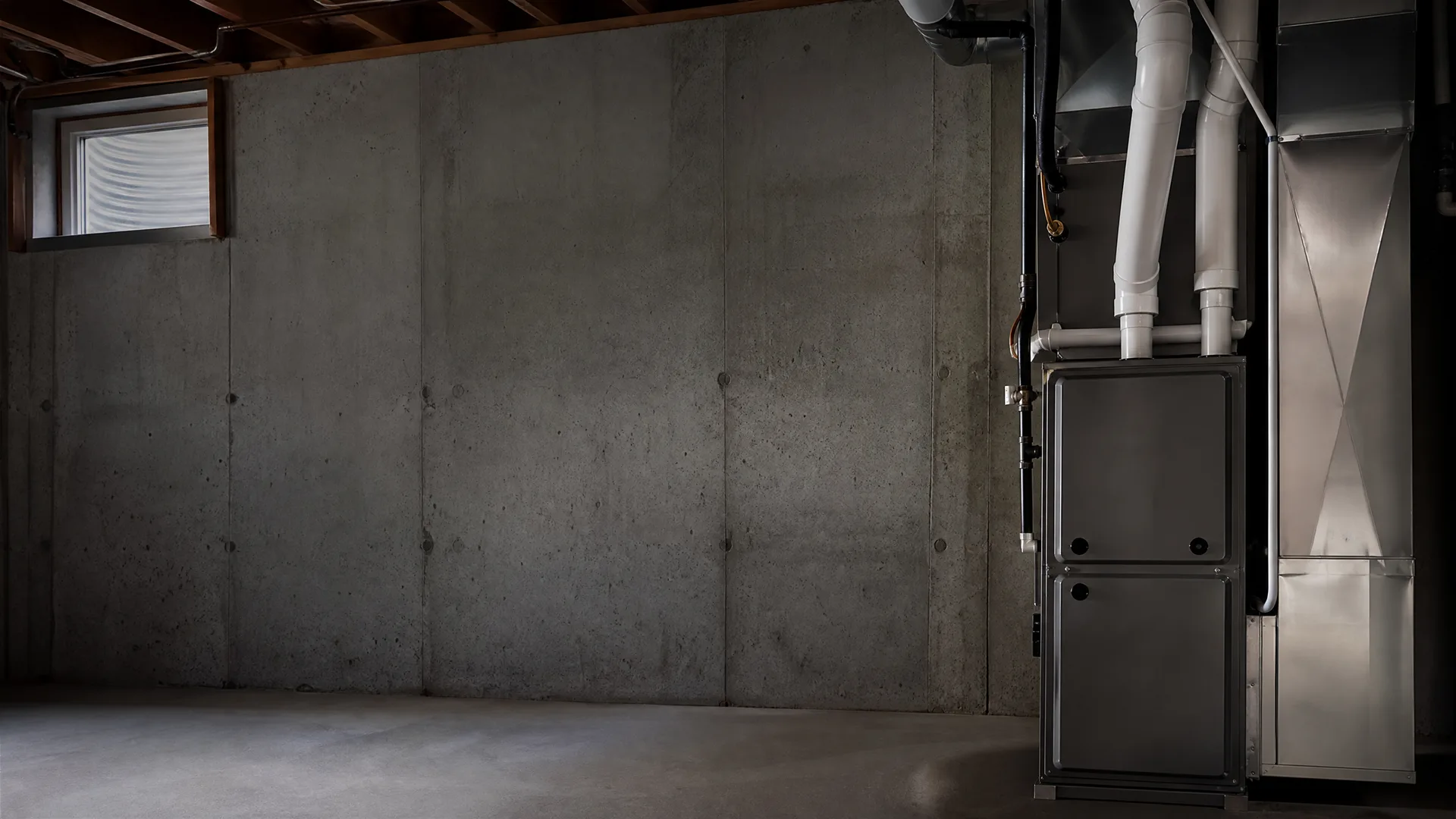
An empty unfinished basement with bare concrete walls and floor, a small window at upper left, and a furnace with white PVC vent pipes and metal ductwork at right.

One form, no calling around

The pro who gets in touch is licensed in Nebraska and works in Hall County.

Step 1 of 3: Equipment